
If you've owned your Palos Verdes, Manhattan Beach, Hermosa Beach, or South Bay home for decades, it may now be worth several times what you paid for it — while your property tax bill has stayed remarkably low, thanks to Proposition 13. That gap between assessed value and market value is exactly what many families don't realize is at risk the moment the home passes to their children.
California's Proposition 19 significantly narrowed the rules that once let children inherit a parent's low property tax assessment. Today, a highly appreciated family home can trigger a substantial — and permanent — property tax increase for the children who inherit it, unless the estate plan is built, and administered, the right way.
You May Be Able to Reduce the Property Tax Increase on Your Family Home
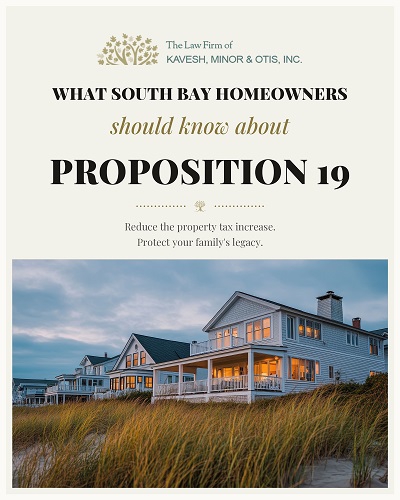
That's why our attorney Philip J. Kavesh created What South Bay Homeowners Should Know About Proposition 19, a free report that walks you through exactly how Proposition 19 changed the rules, and the specific planning opportunities that may still be available to your family — whether you're updating your estate plan now, planning for the future, or already administering a loved one's trust.
This free report reveals:
- Exactly what Proposition 19 changed – Why the "parent-child exclusion" you may have heard about no longer works the way it used to
- The dollar cap on your protected value – How much of your home's appreciation can stay shielded from reassessment right now, and how that number changes over time
- The three key moments for Proposition 19 planning – When to act during your lifetime, while updating your living trust, and during trust administration after a death
- Why simply adding your children to the deed can backfire – One of the most common, and most costly, mistakes South Bay families make
- How to give your successor trustee real flexibility – Trust provisions that can let one child keep the family home without unfairly shortchanging the others
- What to do when the home is worth more than one child's share – Financing strategies that may equalize inheritances without triggering an unnecessary second reassessment
- Special rules for rental and vacation properties – Why investment real estate now faces even less protection than your primary residence
- The filing deadlines you cannot miss – What your successor trustee must file with the County Assessor, and when
Written by One of California's Most Experienced Estate Planning Attorneys
Philip J. Kavesh, J.D., LL.M. (Tax) is a California State Bar Certified Specialist in Estate Planning, Trust and Probate Law and a founding attorney of The Law Firm of Kavesh, Minor & Otis, Inc. For over four decades, our firm has focused exclusively on estate planning, living trusts, trust administration, and probate for Southern California families — designing more than 15,000 living trust estate plans and guiding successor trustees through over 4,000 trust administrations.
That hands-on experience, administering trusts that hold highly appreciated South Bay real estate, is exactly what shaped this report. We've seen firsthand what happens when a trust isn't built with Proposition 19 in mind, and what's possible when it is.
Real Situations South Bay Families Are Facing Right Now
- The couple who bought decades ago for a few hundred thousand dollars – Their home's assessed value is around $500,000, but it's worth $4 million today, creating a significant reassessment gap for whichever child inherits it
- The widow whose $4 million home was only a third of her estate – With $2 million in other assets split three ways, giving the family home to the one daughter who wanted it meant the trustee had to find a way to equalize her siblings without triggering an unnecessary second reassessment
- The family whose decades-old trust simply said "divide everything equally" – Without updated trust language, the successor trustee had far fewer options once one child wanted to keep the family home and the others wanted their share in cash
How an Experienced Proposition 19 Attorney Can Help
- Reviewing your current living trust to see whether it gives your successor trustee enough flexibility under today's Proposition 19 rules
- Coordinating advanced lifetime planning strategies for highly appreciated property, when appropriate
- Helping a successor trustee evaluate Proposition 19 options early in trust administration, before any deeds are signed
- Structuring trust-level financing to equalize beneficiaries without triggering unnecessary reassessment
- Identifying the County Assessor filing requirements and deadlines that apply to your family's situation
- Coordinating with attorneys who concentrate specifically in advanced California property tax planning, when needed
Don't Let the Wrong Deed or Transfer Cost Your Family
Once a deed is signed or a transfer takes place, during life or after death, it may be impossible to undo the property tax consequences. If you own a highly appreciated home in Palos Verdes Estates, Rancho Palos Verdes, Rolling Hills, Rolling Hills Estates, Manhattan Beach, Hermosa Beach, or elsewhere in the South Bay, the right time to get advice is before that happens, not after.
Complete the form below to get your free copy of What South Bay Homeowners Should Know About Proposition 19 today, and call us at 800-756-5596 if you have any questions!
Get Your Free Report Now
This free report could help your family avoid an unnecessary property tax increase and protect the home you've worked decades to keep. Download it now and you'll learn:
- How Proposition 19 changed the parent-child property tax exclusion
- The current dollar cap on your protected value
- The three key windows for effective Proposition 19 planning
- How trust-level financing can help equalize your children's inheritances
- The filing deadlines your successor trustee needs to know
Don't wait until a deed is signed to find out what it will cost your family. Get the guidance you need to protect your home and your legacy.